This spring I took on the project of sorting and organizing all our pictures from a year of living in Rwanda. Compiled in this video our some of our highlights and a glimpse into our amazing experience living in Africa. Enjoy! - Michael
Monday, June 18, 2012

Monday, November 14, 2011
I Know Now - Michael
I knew then that foreign language is a jumble of nonsense words,
I know now, I just can’t understand it.
I knew then that everyone in the world had food to eat,
I know now, that many people are hungry.
I knew then that water is clean an available with the turn of a knob,
I know now, that it can be dirty, disease spreading, and a mile away.
I knew then that all starry skies are the same,
I know now, that they aren’t.
I knew then that milk comes from cows,
I know now, that each glass must first be squeezed from udders.
I knew then few people ride public transport,
I know now, buses are always crammed.
I knew then that 1,000,000 Rwandans were killed
I know now, that there is so much forgiveness.
-Michael-
Tuesday, September 13, 2011
Jumping Giraffes
Giraffes!!!
Daniel

Daniel

We were driving for about 1 hour in Akagera Game Park, when Nathan and I saw giraffes in the distance. We discovered a track that led to the giraffes and followed it. Through the trees I could see a baby giraffe nursing. (I wonder how giraffe milk would taste?) The baby giraffe was as tall as me!!! It seemed to be only a few days old, because its umbilical cord was still attached. There were birds riding on the back of the giraffes.
In 1986, 2 males and 4 female giraffes were imported to the game park from Kenya. Most of them were killed from poaching during the genocide. But now over the years the number of giraffes has increased to about 75, and we were lucky to see some.
The scientific name of giraffe is Giraffa Camelepardalis meaning 'fast walking camel leopard.' The giraffe is related to deer and cattle, but its closest relative is the Okapi.
Baby giraffes

Giraffe Fun Facts

The scientific name of giraffe is Giraffa Camelepardalis meaning 'fast walking camel leopard.' The giraffe is related to deer and cattle, but its closest relative is the Okapi.
Baby giraffes

- A baby giraffe can run for to 24 hours after birth!
- It knows how to jump within 4 days.
- Drinks milk (or suckles) from its mother, till its about 10 months old.
- It weighs about 110 pounds at birth.
Giraffe Fun Facts

- A giraffe's heart weighs up to 25 pounds!
- A full grown giraffe's neck can weigh as much as 500 pounds!
- A giraffe can go longer without water that a camel!
- Giraffes have black tongues!
- In 1 minute, a giraffe's heart can pump 160 gallons of blood!
- An adult giraffe can kick so hard that it can decapitate (take off) a lions head!
- Giraffes cannot cough!
- Each marking on a giraffe is not the same!
- A giraffe can clean its ears with its 24 inch tongue!
- Full grown giraffes can run up to 40 mph!
Akagera Safari - Michael
 Driving through Akagera National Park was not the roughest dirt road I have been on since coming to Rwanda but it was long, dusty and hot--though well worth it! We packed food and camping gear to last us the weekend. We safaried with our British friends with two boys 11 and 8yrs old. As we drove into the park our conversations and card games ended. Binocs were passed around, field guides were opened, and cameras gotten out.
 We leaned out the windows and climbed on the roof to watch zebras meander through the bush and a male impala lope across the road with a score of females. Occasionally we saw a warthog family trot away through the tall grass with their tails raised high or an African Horn Bill or Go-away bird with a call that sounds like: “Go-a-way! Go-a-way!”

 |
| 2 of the 5 giraffes we saw. The baby still had its umbilical cord. |
After a little while the rolling hills and bush spilled out onto a large open plain of dry grass, dotted with groups of zebra. Here we spotted a family of Masai giraffe: three adults and two young ones, one was so young it still had his umbilical cord.

After driving through the park, we came to our campsite at dusk on top of rolling hills speckled with clumps of brush and acacia. (For those of you who live near our home town, it was very similar to the hills between Redding and Red Bluff during summer). To the east, the hills continued but with the glint of metal roofs and the scattered herds of long horned cattle owned by Rwandans. In the west, lay wetlands and occasional lakes with the Akagera River flowing through on its way to Victoria Lake and the Nile . Beyond the river lay Tanzania
 |
| I got 2 crocs and a hippo to show it's nose for this picture. We saw 8 crocodiles and 5 or 6 hippos in just one small cove. |
 |
| On day 2 we followed the broken branches and giant scat piles of this guy till we at last caught up to him. |
 |
| Our muffler fell off on our way out of the park The rough roads weren't very kind to the car. |
The East African animals are not as numerous in Akagera Park as some parks in Kenya or Tanzania. The park’s land was reduced to nearly 2/3 to provide land for returning refugees after the ’94 genocide. Lions, if any, have been reduced to a few and rhinos were all poached during the war. But elephants and giraffe have been brought into the park and are increasing. Crocodiles and hippos thrive in the lakes and there are over 500 species of birds. There are also leopards, but we didn’t get to see any this trip. )-;
 |
| Driving across plain in search of giraffes |
Thursday, September 8, 2011
Life with Cows -Nathan
 When we moved into our house, we took on the responsibility of taking care of 3 cows belonging to our landlord--a calf born in October, the young mother, and another female.
  About a month ago, our landlord gave away one of the cows, because he owed a friend who had done him a favor. In a poor African culture where there is not a lot of money, people depend on help from each other to get things done. Giving a cow is not just a nice thing to do, but an obligation. There was a small ceremony and the landlord gave away the healthiest cow, and left us the sick cow.
 |
| cows pen |
 After a few days the mother recovered, and we discovered she was pregnant again!! Her last pregnancy was triplets, and only one survived. We called a local cow vet to check for brucellosis, a disease that can kill the cow and make people sick. Thankfully, the test came out clear. We also took a 3 day training in animal husbandry and gardening to learn more about caring for the cow and preparing for the birth in November.
 Since the training we have developed a routine that includes washing the cow, cleaning the stalls, and Michael and I milking. We get about 4-5 liters a day but hope to get more after the baby is born. We haven’t yet started making cheese, but make yogurt and kefir daily, and we sell any extra milk. Our cows don’t give very much milk because of their breed—local and a small part Friesian. There is another local cow-the long horned Ankole cow-that also doesn’t give very much milk (only 1-2 liters a day).
 We have really enjoyed having cows, we have learned a great deal, and are having a very good experience. And I hope to expand to chickens, rabbits and maybe goats in the future.

Wednesday, August 24, 2011
A Schooling Adventure- Michael
A few weeks back we visited a rural primary school 1 ½ hours south of Kigali with a volunteer who was working with teachers to improve teaching techniques. We observed and helped the teachers as we could. We came the week before final exams and the end of the school year for Rwandans. The students were reviewing and preparing for the tests, which is a big deal for most of them. The attitude about school is very positive. It is the only way for people to rise above the poor farmer status.
 We split into groups and helped in different classes. I helped and observed in P5 (5th grade) English and math class and P2 (2nd grade) math.

 In Math class, we worked with the local teacher and set up a quiz to review. The math was in English so it was easy to communicate. We divided the class into teams and kept score so that there was competition. We quizzed them with simple problems like finding the area of a square and circle. The kids were good, but when we asked them to find the area of a triangle they tried to solve it with the Pythagorean Theorem!?!

Handball with the School Kids- Nathan
 For 3 hours we observed and sat with the patient, energetic, and eager kids without a break. Along with my mom, brothers, and friends I helped teach colors with bottle caps to the P1 class (1st gr), explained prepositions and helped explain the meanings of difficult English words to the P5 class (5th gr), reviewed simple geometry with the P6 (6gr)class, and also observed classes taught by the Rwandan teachers.

 For the break we played sports with the kids: volleyball, football (soccer), a Rwandan version of duck, duck, goose, throwing javelins, and handball. Daniel and I went with the handball group. My brother and I had never played handball before, but we learned fast with the kids help. When we came to the handball field, I could not tell a difference between it and a football field, except the smaller topped off goals and semi-circles.
 Handball is a combination of rugby, and football. It is mostly the same as football except using hands instead of feet. Passing the ball in the air, we made our way down the dirt field to the goal. To score, we had to throw the ball into the goal and not cross the semi-circle line around the goal. There were a lot of long throws, so the ball traveled fast, and we traveled fast to catch it.

 We split into groups and helped in different classes. I helped and observed in P5 (5th grade) English and math class and P2 (2nd grade) math.
The P5 classroom, 25ft long and 15ft wide, was very basic with two large blackboards and a few hand drawn posters on the wall. About 70 kids shared 18 wooden desks with 3 or 4 others. The desks were only a meter long. The class had kids of many ages. Most looked around 12-13yrs old (it is hard to tell because many are malnourished and smaller than they should be). Some were 15 and 16yrs old.
We listened to the local teacher and observed the kids work. They copied a paragraph in English and answered questions about the paragraph. When someone answered correctly, the class would clap and chant:

“Clap for him!
Another day
do the same.”
The teacher gave them a comprehension test about the paragraph. I observed the students around me work; a few answered correctly, but most did not seem to understand or know what to do.
So English classes in Rwanda are a bit rough. The country switched from French to English in the schools 2 years ago. Teachers needed to learn and teach English overnight. All the teachers have a strong accent, making it difficult for the students to get the correct pronunciations.
Most teaching in public schools involves writing information on the board and having the students copy and memorize with little or no understanding. A lot of the kids in P5 could not hold a conversation beyond “How are you.” with me.
 In Math class, we worked with the local teacher and set up a quiz to review. The math was in English so it was easy to communicate. We divided the class into teams and kept score so that there was competition. We quizzed them with simple problems like finding the area of a square and circle. The kids were good, but when we asked them to find the area of a triangle they tried to solve it with the Pythagorean Theorem!?!
 We learned a lot and appreciated the experience. It made us appreciate our ways of learning and doing school. Also made us realize the need for helping teachers to learn English better.

 For 3 hours we observed and sat with the patient, energetic, and eager kids without a break. Along with my mom, brothers, and friends I helped teach colors with bottle caps to the P1 class (1st gr), explained prepositions and helped explain the meanings of difficult English words to the P5 class (5th gr), reviewed simple geometry with the P6 (6gr)class, and also observed classes taught by the Rwandan teachers.
 For the break we played sports with the kids: volleyball, football (soccer), a Rwandan version of duck, duck, goose, throwing javelins, and handball. Daniel and I went with the handball group. My brother and I had never played handball before, but we learned fast with the kids help. When we came to the handball field, I could not tell a difference between it and a football field, except the smaller topped off goals and semi-circles.
  Handball is a combination of rugby, and football. It is mostly the same as football except using hands instead of feet. Passing the ball in the air, we made our way down the dirt field to the goal. To score, we had to throw the ball into the goal and not cross the semi-circle line around the goal. There were a lot of long throws, so the ball traveled fast, and we traveled fast to catch it.
Though they played hard, many of the kids were malnourished. Some had distended bellies, others were very short, possibly from lack of good food. Most of the kids were 12 and up, and I was about 1 ½ feet taller than all of them, including a 16 year old boy.
We played and played, sweating in the scorching midday sun. I sure got tired out, but the kids though malnourished, gave us a run for our money.

Rwandan Pottery by Daniel

Creating Pottery - by Daniel
Early one morning we got up to go birding and discovered a pottery operation in the marsh we were exploring. We decided to visit the shop, and when we got there the Rwandan staff gladly gave us a small tour. We saw how they grind the clay into powder, how they make small pots on a wheel, and how they fire pots in the furnace. Whenever pots need to be put into the furnace, hte brick wall has to be torn down and then built back up!
After the tour we saw a man creating a pot on the wheel. When he was done he motioned for us to come and try it. So we had a little lesson at the wheel.
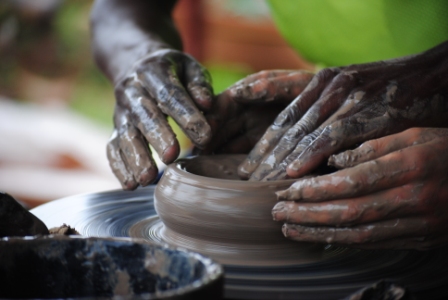

It was very interesting and fun. At the bottom of the wheel is a bigger wheel that I turned with my foot to keep the small wheel up at the top spinning really fast. After finishing they said that we could come back in three more days and it would be fired.


Subscribe to:
Posts (Atom)