Search This Blog

Friday, July 22, 2011

Birthday Hike -Nathan 

On my mom’s birthday we went for a hike.  We looked at our map of the area and picked a mountain to climb, driving on windy ‘moon dust’ covered roads to get to it.
About a mile before our destination, we saw kids playing football (soccer) on a dirt basketball court.  Of course when we stepped out of the car to play, we had a crowd around us.  We divided into teams and started to play.  They were very good, quick on their feet and good with the ball.  During our game, a church service let out and we had another crowd, laughing, pointing and smiling at us as we played.  We must have looked funny.
 After some time some kids brought out 2 spinning tops. They whipped the tops with a string (strip of cloth) tied to a stick.  The spinning top itself was an upside-down cone, a little smaller than my fist, whittled from a piece of wood.  Each time they whipped the top, the string made a snap when it wrapped around the top, and set it spinning.  Each kid took turns whipping the top until it stopped.  When we tried we found it was a lot harder than it looked; my brothers and I, whipped the dirt more than the top at first, but soon we got the hang of it. While we were playing, mom and dad were talking with the high school students from the school next door. They were laughing. 
We played with the kids for a while longer before we started our hike.  As I walked away, one of the kids came to me saying “Gift for me” (meaning ‘gift for you’) and handed me the spinning top!!  I was honored by his generosity, and thanked him in my beginner Kinyarwanda. 
The hike took us to a small peak.

The peak was practically next to the road, but we followed a small trail winding its way around the hillside to many houses.  At each of the houses kids came running to join us.  We stopped for lunch at a point overlooking the valley, gave each kid a piece of bread, and ate together.  I took out the spinning top, and the kids immediately asked if they could try. (Spinning tops were probably one of the favorite toys of EVERY kid!!) They were very good at it, and each time we came to a flat spot on the trail, they begged me to have a try.


We continued on around the hillside, walking over a patchwork quilt of cultivated landscape—maize (corn), beans, carrots, cabbage, sorghum, wheat, pineapple, cassava, sweet potatoes, Irish potatoes, and flowers.  
sorghum
cabbage

maize (corn)


wheat


flowers


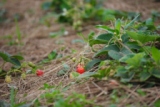
We even saw for the first time rosemary, thyme, and a strawberry patch.  We would not have seen the strawberries except the kids led us to it.  We pulled out our lunchboxes and filled them to the brim with small sweet strawberries.  Mom picked rosemary and thyme for her garden at home.


Near the peak we came to a small eucalyptus forest. (These trees are grown for their tall straight wood and are also used whole in the framework of mud huts.)   The air in the forest smelled very clean and sweet, unlike the fumy air in the city. 
On the other side of the forest we climbed up to the high point and could see the road again.  As we gathered by the car at the end of our hike the kids played with the spinning top until we had to go; they sure loved it!!


 It was an enjoyable hike, especially for just picking a place on the map without knowing anything about it! And my Mom enjoyed it very much, (so that passes the test!!)

Wednesday, July 6, 2011

ADVENTURES AT LAKE KIVU

Lake Kivu--Michael
We spent last week at Kivu Lake.  It’s a 2.5 hour drive from Kigali through hilly eastern Rwanda.  Dad had to meet a World Bank team at the beginning of the week at a hotel in Kibuye.  We came early and spent part of the weekend with him before he took off with the team to check on projects elsewhere in Rwanda.
Lake Kivu spreads across 60mi of Rwanda’s eastern border with the Congo.  It 875 sq. mi and over 1500 ft. deep, making it one of the 20 deepest, most voluminous lakes in the world.  Kibuye is one of three main towns on the lake (including Gisenyi, Cyangugu and Kibuye…look them up!).  The town is the main city of Karongi District. Compared with Kigali, Kibuye is very small and relaxed; its schedule centered around fishing. 
Walking around Kibuye and fishing communities we did not get nearly as many stares and cries of “Mazungu!” as we do in Kigali.  Most of the people we met were kind, gracious and helpful.  Two boys who spoke a small amount of English helped us find a boat to explore the islands and some fishermen showed us how they mended their nets.
While we were there we swam, walked, explored islands, boated and relaxed.  We saw millions of bats, learned how fishermen mend their nets, and met the Olympic swimmer of Rwanda and saw swimming cows.  


Thursday, June 16, 2011


Foltas in Rwanda

So much has happened since we have last posted..its not easy to keep up.  We have moved out of our house in the city to a house with land for animals and a beautiful view.  Though pretty, it has had its challenges as we have not been able to establish solar power to run our fridge and are having to come to town every day for power and internet to continue homeschooling.  With more space we have expanded our family with our Molly- golden lab, ever growing in size and lovability, our 7 week old kitten, Kibby (Kinyarwandan for sunset)  and her mama, 2 cows and 1calf.  Big learning curve.  We are making yogurt daily (no fridge) and are looking forward to learning cheesemaking (with fridge).   Rwanda has a 1 cow 1 family policy but cows are not allowed to freely graze so the cows have to stay in their pens for most of the time.  I wouldn't include cockroaches here, but they came with the house and they are big and take up too much space! 

 It is amazing to see electricity, cell phone technology and internet availability here, though as we had grown accustomed to it, it has been doubly hard to give it up in our new home.  Hoping to find solutions but in the meantime communicating is more challenging--especially our violin -by-skype-lessons.   Meanwhile we are having great adventures in and around Kigali.  Moved out last week to Lake Kivu, to explore another part of the country.  You will hear more about it in another post....here are a few adventures in and about town........ 
 
Mt. Kigali -Nathan
One Sunday afternoon after visiting a Rwandan church we hiked up one of the “thousand hills of Rwanda”, Mt. Kigali. 

Mt. Kigali is not really a mountain, but a big hill near the city.  We drove up the steep, water eroded roads just on the outskirts of the city.  Weaving around small shack houses here and there, we rapidly ascended the base of the mountain, and continued to what seemed to be the beginning of a trail.  As always there were lots of kids and a few men that followed our car, and they surrounded us as we got out.   Most of them said “muzungu, give me money” or “I watch car” in broken English.  One of the men could speak Swahili, so my dad (who knows Swahili) told him he could watch the car for payment; the man readily agreed.
Here in Rwanda it is mostly very safe. But as foreigners it is necessary to have someone watch the car; because sometimes poor people have a different mindset about taking things from muzungus who have so much (it is very cheap to have someone watch your car, probably around 500RFR- .80USD for a full day.)

Not knowing where to start, we took our own path up, passing through tall skinny eucalyptus trees and crossing deep hand- dug trenches (these are to prevent erosion). The hillside was steep and rocky, and it was a difficult climb.  We ascended rapidly, the view becoming more and more spectacular looking over the city and beyond.
We soon came to a road gradually winding its way up. Hiking along the road we saw monkeys for the first time.  Running up closer we watched them leap from tree to tree.  A few curious ones swung down closer to investigate us. They were grayish brown with a dark face, short furred, and a little bigger than a full grown cat. These, we later found out, were called Vervets.  Every little step we took closer, they climbed further away avoiding us and our camera!  Soon, we came to a military camp and had to end our chase.  Since the Genocide there are lots of military camps around, and it is best not to be seen with a camera near one, because most people (especially soldiers) don’t want their picture taken; and they can take your camera away.  

Hiking away from the camp we found some  eucalyptus trees, junipers, and some others, including one interesting tree that had long, pointy, stiff leaves, and palm treelike trunks. It grew in columns, branching out of the main body. 
The trees blocked out most of the view at the flat top of Mount Kigali, but on the way down we crossed a small ridge that overlooked the city. It was then that I saw again just how hilly Kigali is. Rwanda truly is “a land of a thousand hills!!!”


Climbing Kabuye -Michael

Sunday, the week after Mother’s Day, was our first family expedition outside of urban Kigali. We were not able to fully celebrate our mom the week before so we jumped at the excuse to celebrate again. Top on her list of favorite things to do is hiking and spending time together in nature, so we drove to a mid-sized mountain in the north some friends told us about. 
It took an hour and a half to drive through the hills of northern Rwanda.  Being a small country of 10,200sq mi, it takes only a few hours to access almost anywhere within its borders.  Most of the main roads are paved and the driving is smooth—apart from dodging walking people and mini-bus taxis along the windy roads. 
Rwanda is the most densely populated country in Africa. One of its few resources is its rich soil and ideal climate for crops. As a result, the hills, though very steep, are completely cultivated.  Farmers grow corn, sorghum, cassava, plantain (banana), potato, and sweet potato.  They also grow tea and coffee—the main exports of Rwanda.  In fact, Rwandan coffee is rated among the top three in the world. 
The land is spectacular.  It is textured with different crops and varies with shades of green and patches of brown freshly plowed fields.  The glint of corrugated steel roofs and dull red tiles sprinkle the hills, (there are no traditional thatched huts because the government has banned them).  Seemed like we were a matchbox car driving among the rumpled folds of a patchwork quilt. My camera was constantly out the window. 
            We drove as far as possible and left the car at the middle sized town of Kabuye.  Rwandans gathered around offering to watch our car and to guide us to the top, for a little money—of course.  None of them knew English or French so we picked one who spoke the best Swahili (East Africa’s trade language) to communicate through dad who knew Swahili from Kenya.  We brought backpacks, water, lunch, and rain jackets because the clouds were as large and dramatic as the hills below.  I also brought my tripod and telephoto lens, which I never used.  I found my 18-55mm lens to work well for landscapes and close-ups.  
The road went only a little ways from the town and soon morphed into a small foot path.  Many narrow paths spread across the hills between fields and huts, some following contours, some zigzagging through fields, and others climbing straight up the hill.  We took one that directly ascended Kabuye .  It was very steep.  Foot-wide steps were cut into sections of the path, but other parts were rutted by the heavy, sporadic rains.  A group of around 8-10 joined us as we hiked.  We learned new Kinyarwanda words and counted in Kinyarwanda as we hiked.  As a sign of friendship, some hiked with us hand in hand.
Because the land is so hilly, cultivating the steep sides is the farming technique. Within the first hour of hiking we saw the difficulty of growing crops on the steep slopes and a realistic idea of how hard it is for the farmers to survive.  Also, we saw many children bringing up water from the valley or a nearby spring each day.       
            I hiked with my camera around my neck.  I felt like a wealthy tourist at first, and out of place with the poor farmers. (I wonder if we will ever be able to overcome that barrier).  Our guide and friends we picked up enjoyed having their picture taken and seeing it on the  2” screen. 
            The top two-thirds of the mountain was wooded with eucalyptus trees and the ground covered 3” deep with moss.  The bare ground was moist and slippery. Our friends found some bamboo poles for us to use as walking sticks.  From the top we could look down on the fields and lower hills, almost directly below us.  It was somewhat of a hazy day and the hills gradually faded away.  In the distance we could see the shapes of a few volcanoes further north on the border of Congo. 
            Our many guides along with some children that had joined us along the way led us down a different way and showed us a cave at the base of a cliff of rock.  It large -20 feet back. 
            From there we descended the hill until we reached a path, and came back through the fields and huts to the car, arriving just as the last light was fading.  In all, it took us five hours round trip.
    

Vervets Monkeys -Daniel

One day we were climbing Mount Kigali (more like Hill Kigali, it only took us about 1 hour to climb it) and saw our first wild monkeys, at least it was Nathan and my first time.  They were vervets.  Some were playing and jumping from tree to tree; they can jump really far.  A couple of them came down a tree to the ground about twenty feet away from me.

About vervets
Vervets are mainly vegetarians but they also eat: eggs, baby birds and sometimes rodents and hares.  They rarely drink water, and can vary in color and size, but the vervets in Rwanda are light brown and gray.  They can live in mountain areas up to 13,000 feet, but do not live in rainforests or deserts.  We saw them at about 5,000 feet near the top of Mount Kigali.
Vervets are also afraid to go far away from the trees because they can be eaten by predators including leopards, baboons, large eagles, crocodiles and pythons.  Pythons often wait at the bottom of a tree to attack a monkey as it climbs down, and sometimes they swallow it whole!  We have not seen a python, but they might be here.  When vervets are in danger or hurt they scream and squeal.  
                                                                                                                                                                                                                                                         
Vervets are very good climbers, jumpers and swimmers.  They are not only good swimmers but they can swim under water for long periods of time.  They are very keen on grooming themselves; they can spend several hours a day grooming to get all the dirt and old fur off.  There is a pecking order  that controls feeding, fighting, mating, friendships and even survival.  Vervets rub their cheeks or chins on trees or rocks to mark their territory.  It releases a strong scent so that other monkeys can know to stay away.  

Since climbing Mount Kigali, I have seen several other vervets.  We have seen them hiking out of town near the house we are in now.  I enjoy looking for them when we go hiking.


Saturday, May 14, 2011

Life in Kigali

Mothers Day
1 month later—well some of you know we got here though it was on April Fools day and the boys missed a great opportunity to create all kinds of scenarios that “happened” along the way…..Communication has been a bit difficult but we are finally getting it together a little.   Life has been full since we landed with all 9 of our suitcases, violins, and computer bags.   We have been staying with an Ethiopian colleague of Dans who graciously let us move in and take over while our house 20 minutes out of town is slowly getting ready—with a lot of prodding from us.  Azene (our housemate) has become our great friend helping us navigate through lots of new territory as we have settled in. 

Dan pointing out our house-to-be on a hill far away

 
one way confusion
Dan works long hours and is sometimes out in the field for days.  He enjoys the work but not the long hours.  The good news is his absence has kicked me (Meg) into the driving scene ready or not.  Africans walk wherever they go, but in the city, those who can afford it drive, but not according to rules we are familiar with.  CRAZY driving kept the boys and I home for a few days until all the necessities we needed forced us out into the streets and shops of Kigali.  Now we are flowing through the roundabouts and pot-holed side roads less white knuckling than before.  


setting up house-building furniture

1 of 2 muzungu stores in Kigali

Speaking of necessities…shopping here is NOT a one stop shop.   We are trying NOT to get too used to the Muzungu (white expat) stores that have familiar foods we know and love; and trying to get to know all the little grocery shops and markets where the locals go.  There are shops for everything-- curtains, butcher, seeds, hardware, shoes, flip flops-- where we have to bargain for each item we buy.   
street vendor brooms and spoons
Common markets are the daily or weekly fresh food markets around and outside town with piles of mangoes, pineapples, beans, flour, avocados, passion fruit, ground nuts (peanuts), carrots, cabbage, and bananas………yum. 
burrito fillings
We eat wonderful vegetable and fruit salads every night.  The only down side is the meticulous cleaning of every piece of fruit and vegetable that goes in the fridge. (Yes, we have a fridge here where we are staying, but the house we will be moving to has a very small one that will hopefully run from a couple small solar panels and generator if necessary…cross that bridge when we get there). 


grocery cleaning
    
We have been on the survival mode for a while now, setting up a household here and in the other house.  Making meals averages about  2 hours each not including cleanup.  We hired an orphan  named Pascaline (who only speaks French) who is helping us with some of the time consuming daily house keeping chores that all have to be done by hand.  Now we have been able to settle into some kind of routine including studying in the mornings-learning French and Kinyarwanda, reading about the country and culture, journaling, then getting out in the afternoons to shop or walk around town soaking in the sights, smells, and sounds of Kigali, trying out our Kinyarwanda or French.  Shopping means changing money (Rwandan francs) and making constant mental math conversions.  For daily breaks we have found our way to a pool/tennis club where we come for tennis lessons and swims.  The boys have made fast friends with the Rwandan kids who come after school and play follow the leader off the diving board.  This has been our oasis away from home—rackets, balls and water. 

We are finding  our way setting up this blog (as with everything in our lives) trying to include bits and pieces from all of us.  Sorry it has taken lots of time.  We will continue along the journey and try to post every week.


From Michael:             
First Friends
 Three days after we arrived in Rwanda.  We spent Sat and Sun driving with dad around Kigali, seeing his work and workplace, doing a little shopping, going to church, meeting people, learning how to say hello, and eating avocadoes and mangos three times bigger than in the States and ten times better.  Now it was Monday, Dad was at work and all our stuff was still packed in bags unable to be unpacked until we move in to our rented house.  We had slept most of the morning, and worked on French and Kinyarwanda, but now we felt somewhat trapped within the walls of our compound with not much to do.  Outside of the compound, Daniel, Nathan and I could hear some kids laughing and chattering in Kinyarwanda and scampering in the dirt street by the compound; an orange ball occasionally bounced into sight over the wall.  Curious, we went out of the gate and saw about 7 kids juggling a soccer ball in a circle.  As we came out of the gate the ball stopped, and all the kids turned to look at us. 
We had met a few Rwandans during our first few days and of course we had been around them while shopping and at church.  We had at least been able to communicate with the ones that new English, but we had not been among any kids yet. Kinyarwanda is the local language that everyone knows, but a good many—at least the educated—know French, English, or Swahili (East Africa’s trade language). 
“Muraho” we said, breaking the silence that had quickly grown between us and the kids, (Muraho is a greeting like ‘hello’).  They smiled, a few replied back, most giggled.  “Nikwa Michael.” I said—the only other phrase I knew meaning “My name is…”.  “Meekal”  they repeated.  I pointed to the boy next to me and he said his name.  It was a long African sounding name and I tried to repeat it and he had to tell me several times.  At last I got it, but I then promptly forgot it as all the others told us their names and shook our hands.  I did remember one boy’s name who seemed close my age.  His name was Eric.  
They began to play again and we joined in. Some of them where very good at juggling though they only wore flip-flops or just went bare footed.  We counted to see how long we could keep the ball off the ground. Soon more kids came and with only hand motions and few English words, they showed us a couple games they liked to play.  We played for about an hour, until the owner of the ball had to leave.  We then got out our ball that we had brought and played for another three hours.  We were even were able to teaching them a game that we knew.  The temperature was probably only in the eighties, but it was humid and we were all sweaty and tired by the time we had to leave for supper.  Our soccer ball that was bright white and new was now faded, scuffed up and a tan color, but it did not matter.  We had made at least 15 friends with only a few words and a lot of fun and laughter.


MOLLY
laid back Molly
Muraho (Hi), this is Daniel --  I want to tell you about our new dog here in Rwanda.  Her name is Molly and she is six months old and very clever and obedient; each time we come home through the gate she is there waiting for us.   She loves to play and wrestle.  One time we took her on a walk and used a purple leash, but we did not know that purple is the color of the genocide, and the Rwandans do NOT like dogs.  So the police came to our house and threatened to take dad to prison.  Genocide week every year is a very serious week  (1st week in April when we arrived).  All OK though because we didn’t know, but the police took our purple leash away and we said we did not know.  Thankfully we brought a second leash that is red so we used that instead.  Whenever we go on a walk with Molly, the kids on the street come up to her touch her and run away, but some kids have gotten used to her and pet her. 


From Nathan -gardening in Gahanga
At the house we are going to rent in Gahanga (a district about 15 minutes from downtown Kigali,) we have a very large compound (a walled area around the house).  We have 2 milk cows and a young calf penned in the corner; they are definitely not the friendliest cows especially when they are out (they sometimes charge me when I get too close.)
The rest of the sloped yard is mostly grass, bushes, walkways, and lots of different fruit trees including mango, papaya, avocado, and 2 others I don’t know the name of. The fruit here is delicious, at least 3 times better than any in the states. (pictures later)
white boy and street kids 
We had a garden dug out for us and planted seeds we brought from the states and seeds we bought locally.  Communicating to the two non-English speaking helpers was no easy task.  After sectioning off the planting areas, we told them (with the help of a couple Kinyarwanda vegetable names) where to plant.  They first dug a small trench and then sprinkled seed along it, continuing the same method with the onions, lettuce, and cucumber. For the  tomatoes and watermelons, they dug small holes....not exactly how we would have done it but we are learning.
hoped for garden produce
In the late evening, we were rewarded with some rain; at first it was slight but soon it was raining cats and dogs!!  And the wind was probably blowing 50mph, it sounded like a hurricane!!  It was a challenging night to sleep with the noisy weather, and the thought of our digging and planting work all being washed away…..

We are doing well and looking forward to hearing from you!!

with love from Kigali